Perfume families classify fragrances into structured scent groups such as floral, woody, fresh, and oriental. These categories help identify scent profiles, understand perfume composition, and choose a signature scent with accuracy.
Every fragrance belongs to a structured classification system used in modern perfumery. This system groups perfumes by shared scent characteristics. Without this structure, comparing different perfumes becomes inconsistent.
Industry data from organizations like The Fragrance Foundation shows that over 75% of consumers prefer fragrances within one or two scent families, even when testing new releases. This pattern confirms that understanding fragrance families improves purchase decisions and reduces mismatch.
Key Takeaways (Actionable Insights)
- Fragrance families simplify selection. Each family represents a predictable scent profile and performance style.
- The fragrance wheel organizes relationships. It shows how scent profiles connect and transition.
- Four main families dominate perfumery. Floral, woody, fresh, and oriental form the core structure.
- Base notes define long-term scent identity. Ingredients such as vanilla and woods shape the dry down.
- Testing across families improves accuracy. Comparing multiple scents reveals preference patterns.
What Are Perfume Families?
Perfume families are classification groups used in perfumery to organize fragrances based on shared scent profiles, ingredients, and olfactory characteristics.
Each fragrance family represents a consistent pattern of smell. For example:
- Floral → soft, romantic scent
- Woody → dry, earthy scent
- Fresh → clean, light scent
- Oriental → warm, rich scent
This classification system is also called an olfactory family. It allows perfumers and consumers to describe perfumes using standardized terminology.
Key fact: A perfume may belong to more than one family, especially in modern hybrid compositions.
What is The Fragrance Wheel?
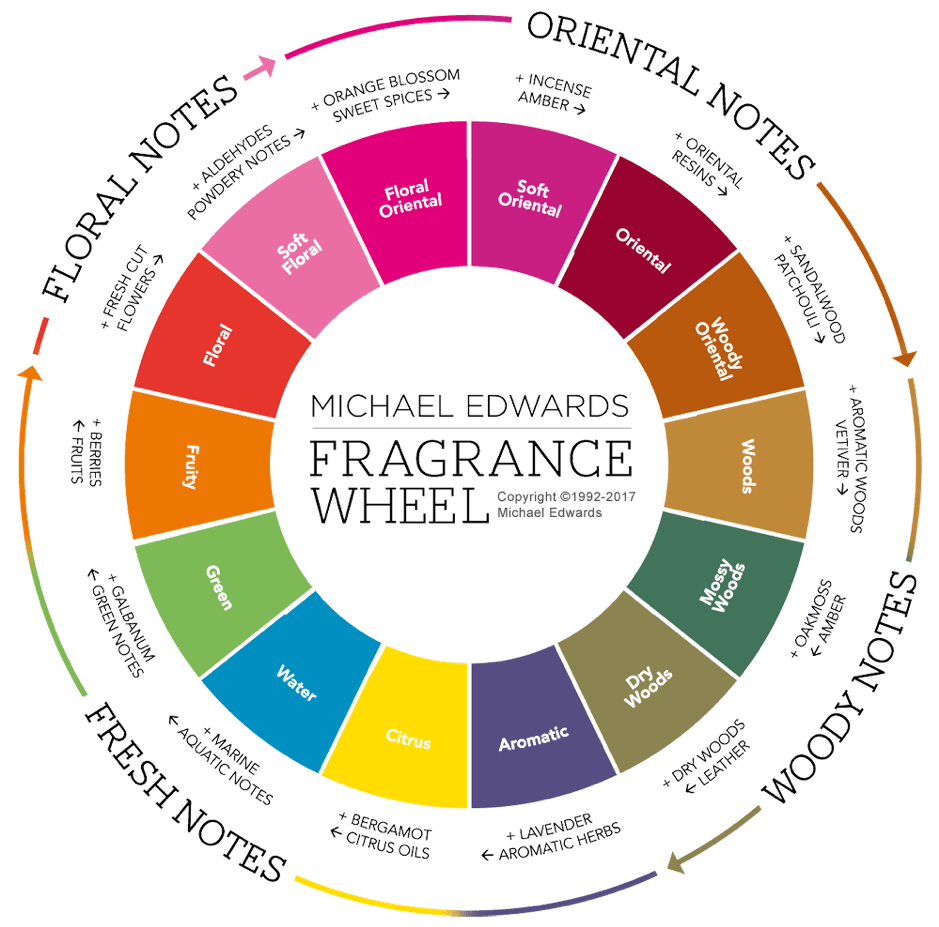
The fragrance wheel is a circular classification model developed to organize fragrance families based on similarity. It visually connects scent types and shows how one category transitions into another. It organizes 14 distinct sub-classes into four primary macro-families.
The modern structure was popularized by Michael Edwards, whose classification system remains widely used in global perfumery.
How the Fragrance Wheel Groups Scents
The fragrance wheel groups fragrance families into adjacent categories:
- Floral → connects to soft floral and floral amber
- Fresh → connects to citrus and green
- Woody → connects to mossy and dry woods
- Oriental → connects to amber and spicy
This structure explains why certain scents feel similar. For example, a floral amber fragrance combines floral softness with oriental warmth.
- Neighboring families (e.g., Floral and Soft Floral) share many attributes and transition seamlessly.
- Opposite families (e.g., Woody and Floral) provide maximum aromatic contrast.
By understanding these transitions, perfumers can create “flankers”—variations of a base scent—that remain recognizable while shifting into a new olfactory category.
Retail fragrance studies show that customers are 40% more likely to purchase within adjacent scent families rather than switching categories entirely.
Main Fragrance Families Explained (Core Classification)
Floral Fragrance Family
The floral fragrance family is the largest and most diverse category in perfumery. It is defined by the presence of botanical blossom extracts or synthetic recreations of flower scents. Floral perfumes are characterized by a high concentration of molecules like Linalool and Geraniol.
- Scent Profile: Feminine, clean, and ranging from powdery to sweet.
- Key Notes: Rose, Jasmine, Gardenia, Tuberose, and Lily of the Valley.
- Attributes: High volatility in top notes, often requiring heavy base fixatives to improve longevity.
Types of floral scents:
- Soft floral → light and powdery
- White floral → intense and creamy
- Floral amber → warm and sweet
A floral perfume often dominates the global market. Studies indicate that over 50% of women’s fragrances fall into the floral family.
Woody Fragrance Family
Woody fragrances utilize deep, earthy, and resinous notes derived from trees and mosses. This family is prized for its structural stability and low volatility, making it the foundation for most long-lasting perfumes.
- Scent Profile: Dry, warm, and opulent.
- Key Notes: Sandalwood, Cedarwood, Vetiver, Patchouli, and Pine.
- Attributes: High molecular weight, ensuring these scents remain on the skin for 8 to 12 hours.
Technical insight: Woody fragrances contain heavier molecules, which increase longevity.
Fresh Fragrance Family
Fresh fragrances are defined by high-vibrancy, citrusy, or aquatic notes. This category is the most volatile, meaning the molecules evaporate quickly, providing an immediate “burst” of scent.
- Scent Profile: Zesty, airy, and energetic.
- Key Notes: Bergamot, Lemon, Grapefruit, Sea Salt, and Galbanum (green notes).
- Attributes: Dominated by top notes; ideal for high-temperature climates where heavier scents become cloying.
Performance: Fresh scents have lower longevity due to faster evaporation.
Oriental (Amber) Fragrance Family
The Oriental family, now frequently referred to as the Amber family, focuses on rich, spicy, and exotic resins. These fragrances represent the pinnacle of sensuality and warmth in perfumery.
- Scent Profile: Exotic, spicy, and sweet.
- Key Notes: Vanilla, Amber, Myrrh, Frankincense, and Cardamom.
- Attributes: Intense sillage and excellent longevity due to the density of the resins used.
Oriental fragrances often show 30–40% higher longevity due to dense base composition.
Sub-Families and Scent Profiles (Advanced Classification)
Classification rarely stops at the four macro-categories. Most modern fragrances are “hybrids” or sub-families that offer nuanced performance.
Floral Amber and Soft Floral Profiles
Soft florals incorporate aldehydes and powdery notes (like Iris) to create a “blurred” floral effect. When blended with amber, they become Floral Ambers, which balance the lightness of blossoms with the heat of resins.
Amber and vanilla molecules are heavier and evaporate slowly, which stabilizes the floral layer and extends the overall scent duration
Floral Amber
Profile: Floral + warm amber/vanilla base
- Lancôme La Nuit Trésor
- Dior Poison Girl
- Elie Saab Le Parfum
- Givenchy L’Interdit
- Valentino Donna Born in Roma
Soft Floral
Profile: Powdery, light, subtle floral scent
- Chloé Eau de Parfum
- Narciso Rodriguez For Her
- Bvlgari Omnia Amethyste
- Estée Lauder Pleasures
- Prada Infusion d’Iris
Woody and Amber Combinations
Woody Ambers are the “powerhouses” of the fragrance world. By combining the dryness of Cedar with the sweetness of Vanilla, perfumers create scents that project strongly and last through external environmental stressors like wind or cold.
Woody materials contain heavier molecules, which reduce evaporation speed and anchor lighter notes.
Woody Amber
Profile: Woody base + amber warmth (high longevity)
- Maison Francis Kurkdjian Baccarat Rouge 540 Extrait
- Initio Oud for Greatness
- Armani Stronger With You Intensely
- Byredo Gypsy Water
- Parfums de Marly Herod
Woody Spicy
Profile: Woody + spices (bold, masculine)
- Viktor & Rolf Spicebomb
- Dior Sauvage Elixir
- Burberry Hero
- Cartier Declaration
- Amouage Interlude Man
Fresh Citrus and Fruity Scents
Fruity scents are often categorized as a sub-family of Fresh. They utilize esters to recreate the scent of peach, apple, or berries. These are frequently paired with citrus to balance sweetness with acidity.
Fresh Citrus
Profile: Bright, zesty, high freshness
- Atelier Cologne Orange Sanguine
- Tom Ford Neroli Portofino
- Hermès Eau d’Orange Verte
- Jo Malone Lime Basil & Mandarin
- Dior Homme Cologne
Fruity
Profile: Sweet, juicy, playful scent
- Escada Cherry in the Air
- Yves Saint Laurent Mon Paris
- Burberry Her
- DKNY Be Delicious
- Dolce & Gabbana L’Imperatrice
How Perfume Notes Define Fragrance Families
Top, Heart, and Base Notes Explained
The classification of a fragrance family often depends on which “layer” of the perfume is most dominant throughout its lifespan.
- Top Notes (Head): The initial 15 minutes. Citrus and Green notes dominate here.
- Heart Notes (Heart): The core for 2–4 hours. Florals and Spices reside in the heart.
- Base Notes (Dry Down): The final 6+ hours. Woods, Musks, and Resins provide the foundation.
Role of Ingredients in Classification
Specific chemical compounds dictate the family. For example, Vanillin is the primary entity in the Amber family. Terpenes are found in Citrus (Fresh) and Pine (Woody). The concentration of these specific molecules determines the final classification on the fragrance wheel.
Ingredient-Based Classification Logic
- Vanilla → Oriental family
- Adds warmth, sweetness, and longevity
- Cedarwood → Woody family
- Adds dryness, depth, and structure
- Citrus → Fresh family
- Adds brightness and freshness
Dominance Principle
A fragrance belongs to the family of its dominant note, not its opening.
Example:
- Citrus opening + woody base → classified as woody
- Floral heart + amber base → classified as floral amber
Concentration Impact
Ingredient concentration affects classification strength:
- Higher concentration → stronger family identity
- Lower concentration → blended or ambiguous classification
Advanced Insight: Molecular Behavior
- Light molecules (citrus) → define opening
- Medium molecules (florals) → define body
- Heavy molecules (amber, woods) → define base
This molecular hierarchy explains why final scent classification depends on dry down, not first impression.
Comparing Fragrance Families
The following table compares the physical performance and use cases for the four primary families.
| Family | Scent Profile | Key Notes | Volatility | Best Use Case |
|---|---|---|---|---|
| Floral | Botanical, Sweet | Rose, Jasmine | Moderate | Daytime, Weddings |
| Woody | Earthy, Dry | Cedar, Vetiver | Low | Professional, Autumn |
| Fresh | Zesty, Aquatic | Lemon, Sea Salt | High | Gym, Summer, Office |
| Oriental | Spicy, Warm | Vanilla, Amber | Very Low | Evening, Winter |
How to Identify Your Scent Profile and Signature Scent
Identifying your scent profile requires systematic testing. Do not rely on the initial spray (top notes). Follow these three steps:
- The Paper Test: Spray on a blotter and wait 30 minutes to identify the Heart notes.
- The Skin Test: Apply to the wrist. Skin chemistry (pH levels and oiliness) alters the scent.
- The 8-Hour Observation: Check the scent at the end of the day. If you still enjoy the remaining Base notes, that family is a candidate for your signature scent.
Why Understanding Fragrance Families Matters in Perfumery
For the Perfume Society and professional perfumers, families are about technical compatibility. Certain families do not blend well due to molecular clashing. For the consumer, understanding families reduces “purchase regret.” If you know you dislike Patchouli, you should generally avoid the Woody family, as it is a foundational ingredient in that group.
How to Choose the Right Fragrance Family (Practical Guide)
For Daily Wear (Fresh & Floral Families)
These fragrances utilize high-volatility molecules and botanical extracts. They prioritize a clean macro-context and low olfactory fatigue, making them ideal for office environments or casual settings in 2026.
1. Fresh: Acqua di Gio Profondo (Giorgio Armani)
- Family: Fresh Aquatic
- Key Entities: Marine notes, Green Mandarin, Rosemary.
- Why it works: It uses Aquozone molecules to maintain a “cold” scent profile that projects without being heavy.
2. Fresh: Light Blue Forever (Dolce & Gabbana)
- Family: Fresh Citrus
- Key Entities: Grapefruit zest, Ozonic notes, White Musk.
- Why it works: High concentration of citrus terpenes provides an immediate, sharp freshness that is naturally invigorating.
3. Floral: Bloom (Gucci)
- Family: Pure Floral
- Key Entities: Tuberose, Jasmine Bud, Rangoon Creeper.
- Why it works: It avoids complex base notes to stay true to its botanical macro-context, replicating a “living garden” effect.
4. Floral: Delina (Parfums de Marly)
- Family: Floral Fruity
- Key Entities: Turkish Rose, Lychee, Rhubarb.
- Why it works: The inclusion of Petalia (a synthetic floral molecule) ensures the rose notes stay vibrant for 6+ hours without becoming “musty.”
5. Fresh: Wood Sage & Sea Salt (Jo Malone London)
- Family: Fresh Aromatic
- Key Entities: Ambrette Seeds, Sea Salt, Sage.
- Why it works: This is a low-sillage fragrance that relies on mineral attributes, making it one of the most skin-friendly “daily wear” options globally.
🌙 For Events and Evenings (Oriental & Woody Families)
These selections utilize low-volatility, high-molecular-weight ingredients. They are engineered for maximum sillage and longevity, ensuring the scent trail persists in crowded or outdoor environments.
1. Oriental: Grand Soir (Maison Francis Kurkdjian)
- Family: Oriental (Amber)
- Key Entities: Labdanum, Benzoin, Vanilla.
- Why it works: The high resin content creates a “linear” performance, meaning the deep amber scent remains consistent from the first hour to the twelfth.
2. Woody: Oud Wood (Tom Ford)
- Family: Woody
- Key Entities: Rare Oud, Sandalwood, Chinese Pepper.
- Why it works: It utilizes Oud (Agarwood), which is one of the densest raw materials in perfumery, providing a “grounded” and authoritative presence.
3. Oriental: Spicebomb Extreme (Viktor&Rolf)
- Family: Spicy Oriental
- Key Entities: Black Pepper, Cumin, Tobacco.
- Why it works: The “Extreme” flanker has a higher oil concentration (Eau de Parfum), specifically designed to cut through cold air and ambient smells.
4. Woody: Baccarat Rouge 540 Extrait (MFK)
- Family: Woody Amber
- Key Entities: Saffron, Egyptian Jasmine, Cedarwood.
- Why it works: It features a massive dose of Ambroxan, a synthetic entity that creates an “aura” of sillage rather than a direct path, making it highly detectable to others.
5. Oriental: Black Orchid (Tom Ford)
- Family: Floral Oriental
- Key Entities: Black Truffle, Ylang-Ylang, Patchouli.
- Why it works: This fragrance uses “earthy” attributes and dark florals to create high-intensity projection. It is statistically one of the longest-lasting designer fragrances on the market.
| Category | Typical Longevity | Primary Goal | Recommended Concentration |
|---|---|---|---|
| Daily Wear | 4–6 Hours | Non-intrusive Freshness | Eau de Toilette / Cologne |
| Evening Wear | 8–12+ Hours | Lasting Impression | Eau de Parfum / Extrait |
Pros and Cons of Different Fragrance Families
Pros:
- Easy Classification: Helps you narrow down thousands of perfumes to a few hundred.
- Helps Selection: Allows you to find “similar” scents to ones you already love.
- Predictability: You know a “Fresh” scent will likely need reapplication, while a “Woody” one won’t.
Cons:
- Overlapping Categories: Many modern niche perfumes (like those from Initio Parfums or Byredo) defy single-family classification.
- Subjective Perception: One person may perceive a scent as “Woody,” while another focuses on its “Floral” heart.
FAQ
What are the main fragrance families?
Floral, woody, fresh, and oriental (amber) are the four main fragrance families. These groups are further divided into sub-categories like citrus, mossy woods, and floral amber to provide more specific scent profiles.
What is a fragrance wheel?
A fragrance wheel is a circular classification tool that organizes scents based on their aromatic similarities and differences. It was popularized by Michael Edwards to help consumers and professionals identify related perfume families.
How do I find my fragrance family?
To find your fragrance family, identify the common notes in your favorite perfumes. If most of your scents contain rose or jasmine, you belong to the Floral family; if they contain sandalwood or cedar, you prefer the Woody family.
Perfume Families FAQ: Fragrance Wheel & Classifications
Understanding fragrance families is the most effective way to navigate the world of perfumery. By using the Fragrance Wheel to categorize scents based on their chemical and aromatic properties, you can make informed decisions about your signature scent. Whether you prefer the high-energy volatility of the Fresh family or the enduring, resinous depth of the Woody family, your choice defines your olfactory identity.