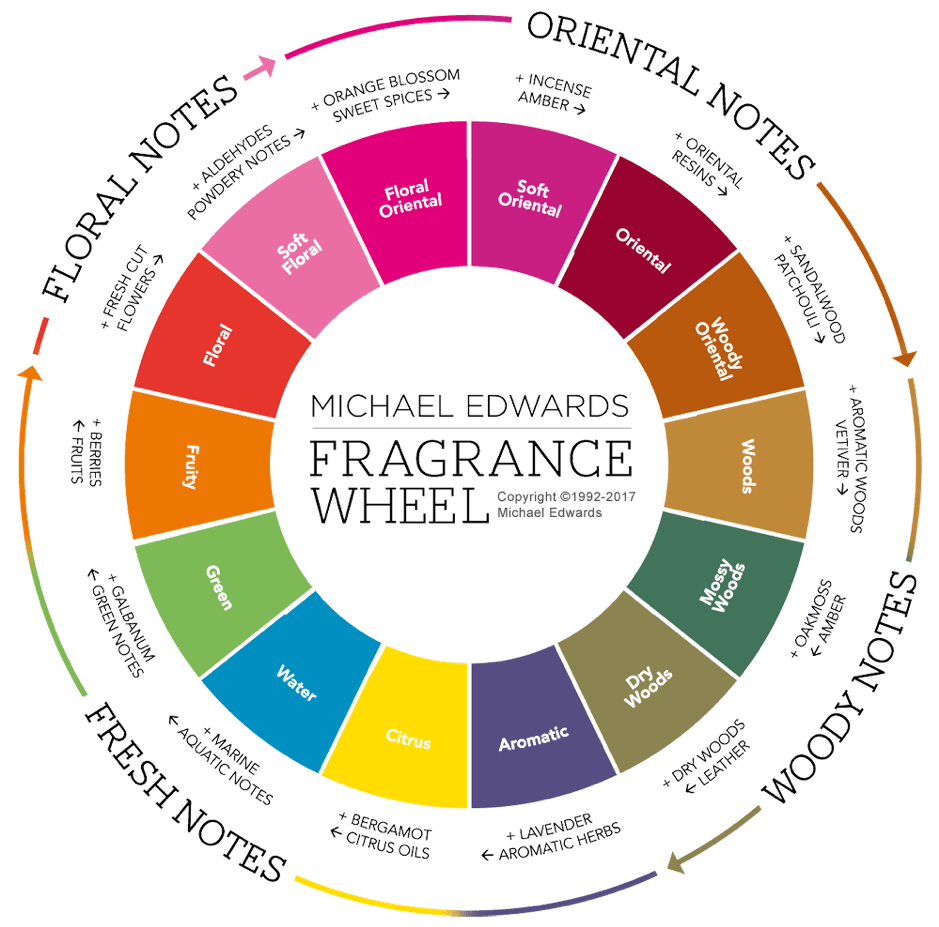
Perfume families group fragrances by their overall smell. Fresh, floral, woody and amber are useful starting points; fruity, aromatic, gourmand, leather and other descriptions add detail. Classification systems differ, and a fragrance can sit between several families.
Choose by overall character
A perfume containing rose is not automatically dominated by flowers. Likewise, a citrus opening can lead into a warm amber base. Ask which impression stays central over the wear, rather than sorting a bottle from one note. Family names help you explore, but they should not overrule your own preferences.
How to use a family comparison
Start with two contrasting samples, such as fresh citrus and dry woods. Once you know which direction you prefer, compare closer neighbours inside that family. This is more informative than buying several similar full bottles from a single reviewer’s ranking.
Build variety without buying every category
You do not need one bottle from each family. If a fresh scent and a warmer scent cover your actual routine, stop there. For a gift, use the recipient’s existing favourites as evidence; a gender label or bottle colour is a weaker guide.
Where the families overlap
Most modern perfumes sit across more than one family. A woody-floral, a fresh-aromatic or an amber-gourmand is common, and perfume houses and retailers often label the same scent differently. Treat a label as the beginning of a description. Two perfumes both called woody can feel very different if one is dry and smoky and the other creamy and soft.
Reading a family label on a product page
Look for the supporting words around the family name: dry, soft, sweet, green, powdery, smoky. These tell you more than the family alone. Then read the listed notes to see which materials drive that character, and check the later notes, because the base is what you will smell for most of the wear. If a listing gives only a family and no notes, a sample is the safest way to learn what it actually smells like.
Families and the season you wear them
Fresh and light florals are often chosen for warm weather, while amber, woody and gourmand styles are popular in cooler months. That is a habit, not a rule. A sheer woody fragrance can work in summer, and a bright citrus can feel pleasant on a cold morning. Choose by how the scent feels on you rather than by the calendar. For more on matching scent to setting, see our perfume wardrobe guide.
Comparison at a glance
| Family or style | Typical impression | Question to ask |
|---|---|---|
| Fresh | Citrus, green or watery | Do I enjoy the later scent too? |
| Floral | Single flower or bouquet | Sheer flowers or a fuller bouquet? |
| Woody | Dry, creamy or smoky woods | How much sweetness do I want? |
| Amber | Warm, resinous or sweet | Comforting or too dense for me? |
| Gourmand | Food-like sweetness | Do I like that sweetness throughout the wear? |
Maison Alhambra products to compare
These editorial suggestions use the scent directions in our catalog. Choose a sample where available and compare the finished perfumes yourself; no measured wear-time ranking is implied.
| Product | Catalog bottle size | Why compare it |
|---|---|---|
| Porto Neroli | 80 ml | Fresh citrus direction. |
| Woody Oud | 80 ml | Woody direction. |
| Kismet Magic | 100 ml | Gourmand direction. |
| Léonie | 100 ml | Floral direction. |
Questions readers ask
Is there one official number of perfume families?
No universal classification fits every brand and fragrance. Use a system consistently without treating its categories as fixed rules.
Does a woody fragrance always last longer?
No. A family is a description of smell, not a measured performance rating.
Read next: Perfume Wardrobe · Clean or Woody? How to Pick the Best Scent for You · What are Fragrance Notes? Top, Heart + Base Notes Explained
Catalog details checked 11 October 2026. Prices, packaging and availability can change. Some product links lead to Amazon; purchases may earn us a commission. Affiliate disclosure.